Friday, May 13, 2011
A Steamy Topic
And you did it! The Little Rock Express route received the most votes and now a schedule has been set. Check the schedule to see where you can meet up with a piece of living history!
After you plan your visit, don't forget to check out some facts about this engine and it's place in history. For example, did you know this engine has been blowing steam since 1944?
Hope to see you at one of the stops of the Little Rock Express!
Wednesday, May 11, 2011
Public Discussion
A complete list of briefings can be found at www.modot.org. If you're unable to attend, you can participate through an online briefing at www.modot.org. The online meeting will run through June 3.
Other ways to comment on the proposed direction:
- Comment online via www.modot.org
- Send an e-mail to MHTC@modot.mo.gov
- Call 1-888-Ask-MoDOT
- Write to MoDOT, Central Office, 105 W. Capitol Ave., P.O. Box 270, Jefferson City, Mo., 65102
- Contact us via social media at www.modot.org/emodot
All comments from the public received during this month-long process will be shared with MoDOT leadership and commission members prior to June 8.
Tuesday, May 10, 2011
Director Keith Presents a Smaller, More Efficient MoDOT
A dramatic decrease in available funding means we have to make the best possible use of every dollar. Watch below as Director Keith talks about why these changes are necessary and how MoDOT will focus on maintaining the safest, most reliable transportation system possible for Missourians.
Wednesday, May 4, 2011
A Bolder Five-Year Direction
"We asked the director to put forth a bold plan of action to address our transportation funding crisis, and he delivered," said Commission Chair Grace Nichols. "We don't like having to head in this direction, but the reality of our funding situation makes it necessary."
Find full details at www.modot.org.
Tuesday, May 3, 2011
Celebrate Safe and Sober
The day I got my license was an exciting day for me. It opened up a whole new world: nights out, trips with friends, part-time jobs, independence.But it wasn't all friends, fun and freedom. With my license also came responsibility. Sure it took me two speeding tickets to figure that out but I did - eventually.
Getting your license isn't a right - it's a privilege. One that comes with strings attached. One of those strings is don't drink and drive.
Between 2008 and 2010, 98 people were killed and 426 seriously injured on Missouri roadways in crashes involving a drunk drivers under the age of 21. What's tragic about these crashes is they are clearly preventable.
It is illegal for a person under 21 to possess or consume alcohol in Missouri. Missouri has a zero tolerance law. If you're under 21, your license will be suspended if you're caught with even a trace of alcohol in your system.
With prom and graduation season here, Missouri youth have much to celebrate. From May 4-13, high-visibility enforcement and education will remind teens and their parents that underage drinking is not only wrong - it's against the law.
Celebrate safe and sober. Zero tolerance means zero chances.
Monday, May 2, 2011
Motorcycle vs. Car
Responsibility falls on motorists driving cars and trucks as well, who need to take care and watch out for the motorcyclists sharing the road. This is particularly important during this time of year, when the weather is warming up and more motorcyclists are taking to the roads.
May is Motorcycle Awareness Month, and a good opportunity for us all to think about safe driving, whether on two wheels or four.
Motorcycle experts recommend motorcyclists complete training before getting out on the road. In Missouri, there are 26 locations for training, and you can find the one nearest you at www.mmsp.org.
And with motorcycle use growing throughout the state, it's even more important for cars to watch out and look twice for motorcyclists. Always make a visual check in mirrors and blind spots before entering or leaving a lane of traffic and at intersections.
Friday, April 29, 2011
Earth Day: Little Changes Can Mean Big Results
"Little Changes, Big Results” was the winning slogan in DNR’s 2011 Earth Day slogan contest. Adeline Forester, a fifth-grade student in Michelle Kemker’s class at the Cole R5 Eugene Elementary School, submitted the winning slogan.
Sometimes it is the little things we each can do that can help make a difference in the overall big scheme of things. I know my family now recycles every little bit of plastic, paper, tin and aluminum. Here at MoDOT, we have won awards for doing that and much, much more. But, that’s the point – we can each do our part both at home and at work.
This event is just one small thing we do at MoDOT to help get the message out. Besides reminding everyone about the importance of picking up trash, volunteers are asking visitors for a promise to not throw trash out in the first place by signing the Litter Pledge.
In addition, visitors to the MoDOT tent have the opportunity to learn more about the Adopt-A-Highway and No MOre Trash! programs. MoDOT staff also handed out more than 3,000 of these trees to Earth Day participants.
The nation's very first Earth Day was held in 1970 and led to the creation of the U.S. Environmental Protection Agency. The official date of the national Earth Day celebration is Friday, April 22.
Thursday, April 28, 2011
Trash Bucket
A new innovation was recently created by a MoDOT employee that makes picking up trash easier and safer. The Trash Bucket was one of five state winners in MoDOT's statewide annual Innovations Challenge, and it will help our state on its way to becoming litter-free.
MoDOT Maintenance Crew Leader Tommie Chitwood used scrap material on hand by cutting the top off a bucket and using the tension ring from the lid to create a bag holder - the holder keeps the bag open and ready for trash. The handle also provides a good grip to hold the bag steady. Volunteers and workers can keep their eyes on the road rather than turning attention away to open a trash bag.
No matter what you use to pick up trash, learn more about keeping Missouri litter-free and consider getting involved today!
Adopt-A-Highway
Sponsor-A-Highway
No MOre Trash!
Getting There -- Is It Worth Your Life?

Usually twice a week, my family and I cross the Union Pacific Railroad track on Highway 179 in Jefferson City on our way to and from church. Each time we hope we don’t get stopped by a train, but occasionally the lights flash, the bells sound and the gates go down to warn us that either the Missouri River Runner or a freight train is coming through. Sure it may be a little inconvenient and it may make us a few minutes late, but getting there – is it worth your life? No!
I have placed a solemn reminder to be cautious at highway-rail crossings on the bulletin board at our church. It’s a news clipping of a car smashed by a train at a nearby crossing. The driver did not survive. On Tuesday, I was delivering the same type of message, just much more directly. Volunteers from MoDOT, the Highway Patrol, Missouri Operation Lifesaver and I met at the Route 179 highway-rail crossing to conduct a Positive Enforcement Program - a key component of this year's Rail Safety Week on April 25-29. We stopped several motorists on both sides of the track to share some important rail safety tips. I hope you will also think about them every time you encounter a train or railroad tracks:
• Always expect a train.
• Never drive around gates when they are lowered.
• Never walk or play on railroad tracks, it’s dangerous and illegal.
• A train always has the right of way.
• Trains can’t stop quickly, so never try to beat one.
• Look, listen and Live!
Tuesday, April 26, 2011
MoDOT Traveler Information Map Offers Flood Information
Most people know about MoDOT’s Traveler Information Map. They turn to it for snow information and work zone locations. But it also offers flooding information, too. Information that could save your life.
Go directly to the map at this address http://maps.modot.mo.gov/timi/
At the time of this blog post, there’s more than 430 flood closures in southern Missouri. The bottom of the map is red with flood icons. If you live and work in any of these areas, please check the map before you travel.
The map is updated continually and is easy to use. You can pan in and out for a broad perspective of statewide road conditions or double click an icon or area to zoom in for a closer view. Hold the mouse over an icon for more details on the route, date, time and condition.
To unstack icons double-click on a region of the map and you’ll zoom in. For a text-only version that gives information by county and route, click on the flooding icon in the legend on the left side of the page.
Saturday, April 23, 2011
Train Your Brain
Take the Train Your Brain quiz, and be automatically entered to win one of several great prizes donated by Missouri Operation Lifesaver, Union Pacific and Amtrak.
Winners will be announced daily on Missouri River Runner’s Facebook page at http://www.facebook.com/missouririverrunnerand MoDOT’s Facebook page at www.facebook.com/MoDOTStatewide.
Friday, April 22, 2011
Chorus Calling
Thursday, April 21, 2011
Why It's Personal
Wednesday, April 20, 2011
My Last Text
Mine were:
- Yes sounds good.
- Just left to go to Home Depot and Lowe's.
- My Contacts Backup last saved your contacts 75 days ago.
But if you're texting being the wheel, that message could be the last thing you read.
Texting makes a driver 23 times more likely to crash because it takes your eyes off the road for an average of five seconds.
In 2010, there were 21 fatal, 69 disabling injury, 477 minor injury and 1158 PDO crashes involving an inattentive driver using a cell phone. Twenty-two people were killed, 85 seriously injured and 679 received minor injuries in these crashes.
Next time you hear the buzz of a text message while behind the wheel, ask yourself if it's worth your life.
A mother and Highway Patrolman tell the story of how a text message cut one young woman's life short.
Tuesday, April 19, 2011
Pain at the Pump
Let's break it down: MoDOT receives 12.45 cents of the 17 cents per gallon of gas purchased (local governments receive the remaining 4.55 cents per gallon) and MoDOT receives approximately $500 million a year from the state fuel tax. The federal fuel tax rates are 18.4 cents on gasoline and 24.4 cents for diesel. The price Missourians pay at the pump comes from four different costs: 65 percent crude oil, 15 percent refining, 10 percent distribution and marketing, and 10 percent federal and state taxes.
Higher gas prices hurt MoDOT because as prices rise, people buy less, which can decrease our funds. Missouri ranks 42nd for fuel taxes, yet we maintain the 7th largest highway system in America.
MoDOT's Chief Engineer Dave Nichols explains more about pain at the pump and how it affects Missouri in last week's To The Point podcast.
Thursday, April 14, 2011
New Bicycle and Pedestrian Attachment
On April 8, a bicycle and pedestrian attachment to the Missouri River Bridge opened in Jefferson City, spanning the Missouri River and connecting bicyclists and pedestrians with the popular Katy Trail.
Work on the project began in mid-May 2010. It was funded by MoDOT, the City of Jefferson, the Missouri Department of Natural Resources, and the Missouri State Parks Foundation.
Watch the ribbon-cutting below to catch some great shots of those already enjoying the bridge attachment.
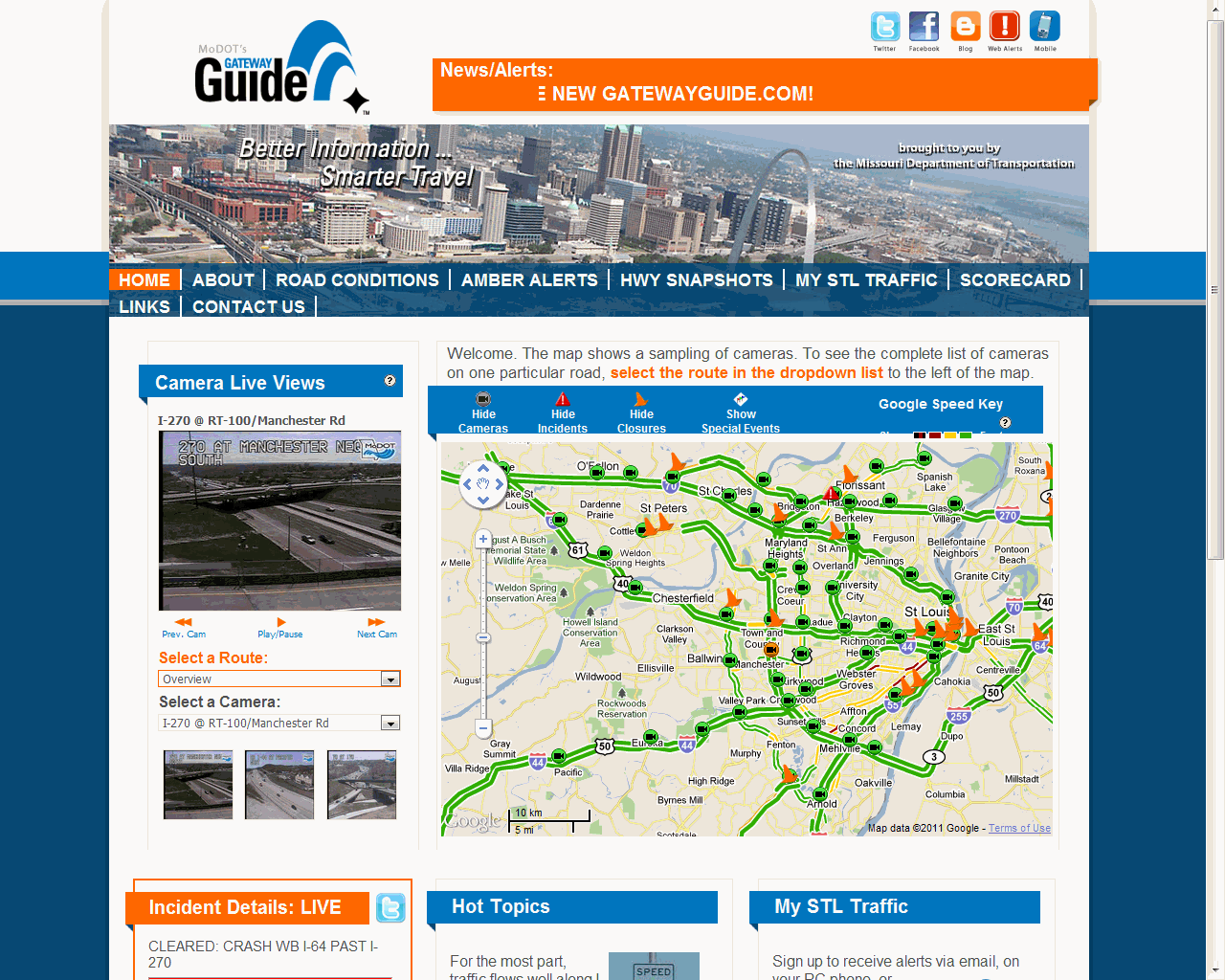
New and Improved Gateway Guide
- shows nearly 300 live-camera views updating every two seconds
- displays real-time information on incidents and work zones with lane closures
- provides personalized My STL Traffic alerts for lane closures on the highways you use and the times you need it each day. These alerts can be sent to you by text or e-mail.
- includes a mobile-friendly version for your smart phone and other cellular devices
- shows real-time @STL_Traffic Twitter alerts
Wednesday, April 13, 2011
Sleeping in the Office
It’s not that way for commercial vehicle drivers. Depending on the circumstances, their work day must end sometime within the 10 or 11 hours since they started work. Have 10 and a half hours on the clock and you’re just 45 minutes from your favorite restaurant? Sorry. Maybe you can stop there for breakfast. For commercial drivers, quittin’ time is federally regulated.
It’s that way because fatigued drivers make more mistakes than those who are well-rested. Seriously, who wants to share a highway with any driver, even one in a sedan, who has been on the road for 12 hours or more? So all of those long-haul truck drivers you see every day have to find a place to pull over, climb into the sleeper and get some shut-eye – in fact, they sleep in their office.
You’re a driver who made it to Missouri? Good. You’re in luck. In addition to traditional rest spots like rest areas (which all welcome trucks) and truck plazas, we’ve got truck-only parking areas. Most began their roadside existence as weigh stations, though several were rest areas in a former life. When they no longer served their original purpose well, MoDOT converted them to serve as safe, convenient, though basic spots where drivers can wrap up their day and get some rest. We’re one state where drivers don’t have to go as far to find a nice place to stop.
Check it out for yourself at www.modot.org/services/travel/restarea. All of Missouri’s rest areas, welcome centers and truck-only parking areas are plotted on a map of the state. The more convenient, safe and plentiful we make truck parking, the more efficient drivers can be, the cheaper the transportation and consumer costs for things like the gallon of milk I need to buy on the way home…and the dog biscuits. I cannot forget the dog biscuits!
Monday, April 11, 2011
New Car Seat Recommendations
When it comes to our children, their safety is paramount. We do everything in our power to keep them safe. One easy way is to buckle them in a car seat. The recently released guidelines from American Academy of Pediatrics recommend keeping your toddler rear-facing until age two. Children under age two are 75 percent less likely to die or be severely injured in a crash if they are rear-facing. The new guidelines also say:
Use front-facing seat with five-point harness straps as long as possible. Many go up to 65 or even 80 lbs. Make sure kids stay in booster seats until they reach 4 foot 9 inches. The typical eight-year-old doesn't reach this height.
But the fact of the matter remains that if you don't have your car seat installed correctly or don't have your child buckled into it, the best car seat in the world isn't going to protect your child. A car seat, even if it's covered in polka-dots, is a serious piece of safety equipment. And it takes some serious know-how to install it correctly.
These are just a few of the things that can go wrong with installation: routing seat belts incorrectly, not putting seat belts in lock mode, using both the lower anchors of the LATCH system and the seat belt, connecting the lower anchors and tethers of the LATCH system to the wrong points in the car, forgetting to use the tether at all, and not putting enough weight on the seat as it is being installed
Rather than fret about whether your baby is really safe in their sophisticated, expensive, top-of-the-line car seat, why not just get it checked out by an expert?
Missouri has more than 200 safety inspection stations. Certified technicians can inspect your child safety seat and show you how to correctly install and use it.
Even if they only tweak your installation a little - the average installation has three errors - you can walk away with valuable piece of mind. If they do a complete overhaul on your install job, you will be grateful they did.
Find a list of inspection stations and the one closest to you here.
Next time you look back and see that adorable, sleeping baby, you'll feel much better knowing that he/she is safe.
Friday, April 8, 2011
Work Zone Safety - A Testimony
Traumatic events typically get lodged into the memories of individuals. Looking back to the events of an otherwise normal weekday in August 1996, they remain ever-present today.
The passage of this day was typical, nothing extra ordinary until late in the day when the stadium maintenance crew began taking down their work zone. For those who are unaware, work zone setup and take-down is often the most critical and highest-risk part of an operation. This is something I experienced firsthand having worked as a maintenance worker in overhead signing. There is an initial unfamiliarity of lane transitions for drivers, not to mention the congestion that occurs when drivers adjust to these changes.
Today was different though. With a promotion to an office position in Maintenance Operations, the responsibilities of two-way radio dispatch came with it. A new job classification meant there was very little to do except to communicate to others.
The call came over the radio, “We’ve been hit! We’ve been hit!”
From the district office my response was “MoDOT4, go ahead.”
The caller responded, “They’ve hit the light trailer, we have men down!”
The urgency of the voice was present --it had to be bad and we needed to get more details.
My response was, “I need you to take a deep breath and answer my questions."
Meanwhile, several other employees entered the radio work area, ready to offer their support, assisting wherever needed. Turning to another employee, I asked them to get a 911 dispatcher on the phone. The finite details: route, cross street, direction of travel, number of injured employees, whatever we could relay to emergency services was given. The events seemed lengthy at that time; however in reality, were only a few short minutes.
In that time the smoothness of coordination was exceptional. Field operations were communicating with the district office and we were relaying to emergency services. Operations management and staff automatically mobilized and took to the field. We had part of our MoDOT family in need and everyone was answering the request for assistance.
In a nutshell, this is what had happened. While MoDOT employees were taking down the work zone, a motorist had collided with the arrow-board-style light trailer, which Raymond McKelvy and Jorge Bermudez were connecting to the back of their truck.
It wasn’t until everything was finished that the accident really hit home. You see, when I hired in, I worked on the stadium campus and knew Raymond and Jorge personally. These were friends, coworkers, employees with families.
We know smaller traumatic events don’t always garner media attention. They don’t burn into the minds of the masses. Perhaps they should, perhaps the reality of potential fatal situations in highway work zones should be a call to our driving public, to slow down and draw cautionary attention. The reality is … it seldom does.
I remember where I was during the first and second space shuttle catastrophes. I remember where I was when the twin towers fell. I will remember the details of that day in August 1996.