Tuesday, April 19, 2011
Pain at the Pump
Let's break it down: MoDOT receives 12.45 cents of the 17 cents per gallon of gas purchased (local governments receive the remaining 4.55 cents per gallon) and MoDOT receives approximately $500 million a year from the state fuel tax. The federal fuel tax rates are 18.4 cents on gasoline and 24.4 cents for diesel. The price Missourians pay at the pump comes from four different costs: 65 percent crude oil, 15 percent refining, 10 percent distribution and marketing, and 10 percent federal and state taxes.
Higher gas prices hurt MoDOT because as prices rise, people buy less, which can decrease our funds. Missouri ranks 42nd for fuel taxes, yet we maintain the 7th largest highway system in America.
MoDOT's Chief Engineer Dave Nichols explains more about pain at the pump and how it affects Missouri in last week's To The Point podcast.
Thursday, April 14, 2011
New Bicycle and Pedestrian Attachment
On April 8, a bicycle and pedestrian attachment to the Missouri River Bridge opened in Jefferson City, spanning the Missouri River and connecting bicyclists and pedestrians with the popular Katy Trail.
Work on the project began in mid-May 2010. It was funded by MoDOT, the City of Jefferson, the Missouri Department of Natural Resources, and the Missouri State Parks Foundation.
Watch the ribbon-cutting below to catch some great shots of those already enjoying the bridge attachment.
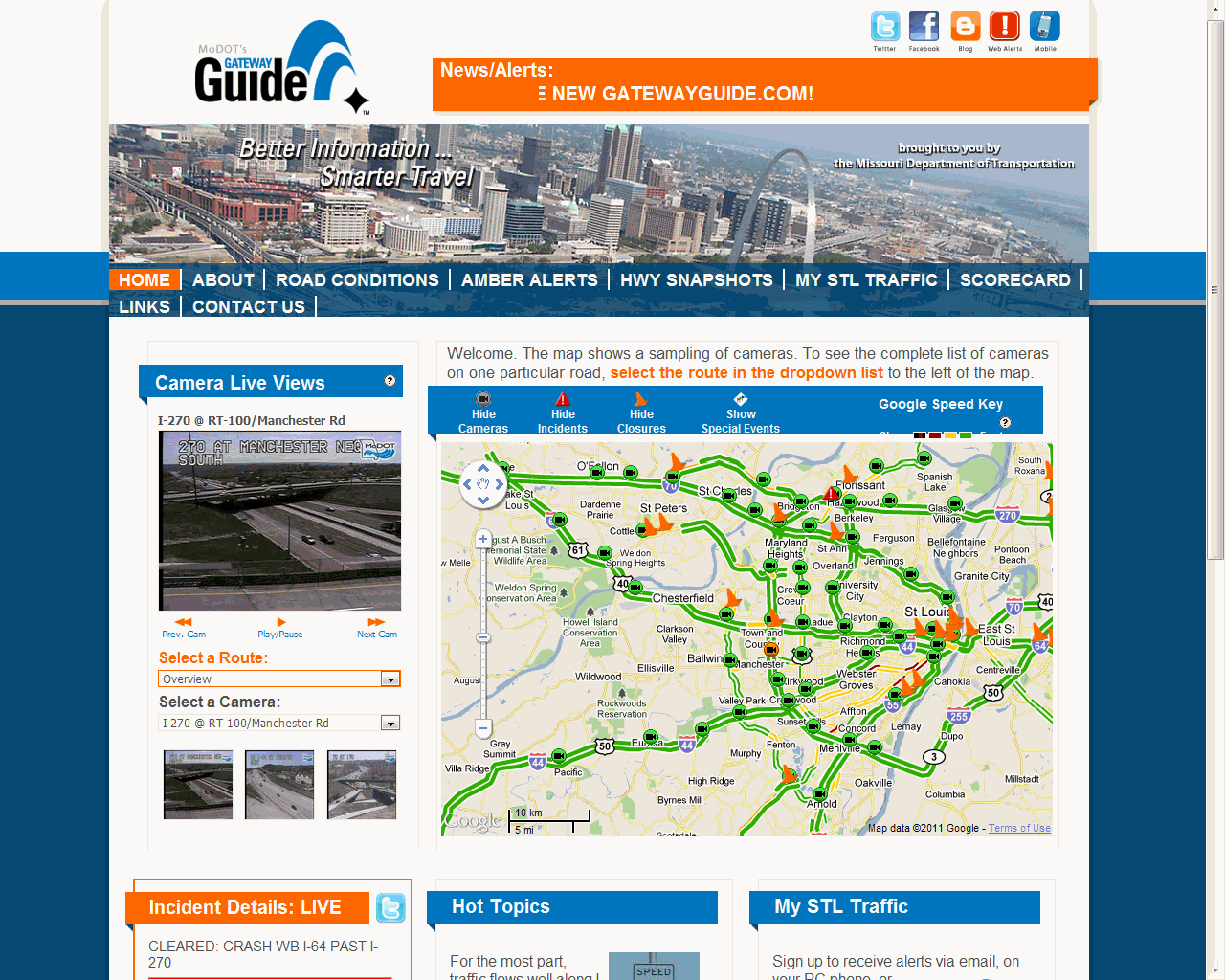
New and Improved Gateway Guide
- shows nearly 300 live-camera views updating every two seconds
- displays real-time information on incidents and work zones with lane closures
- provides personalized My STL Traffic alerts for lane closures on the highways you use and the times you need it each day. These alerts can be sent to you by text or e-mail.
- includes a mobile-friendly version for your smart phone and other cellular devices
- shows real-time @STL_Traffic Twitter alerts
Wednesday, April 13, 2011
Sleeping in the Office
It’s not that way for commercial vehicle drivers. Depending on the circumstances, their work day must end sometime within the 10 or 11 hours since they started work. Have 10 and a half hours on the clock and you’re just 45 minutes from your favorite restaurant? Sorry. Maybe you can stop there for breakfast. For commercial drivers, quittin’ time is federally regulated.
It’s that way because fatigued drivers make more mistakes than those who are well-rested. Seriously, who wants to share a highway with any driver, even one in a sedan, who has been on the road for 12 hours or more? So all of those long-haul truck drivers you see every day have to find a place to pull over, climb into the sleeper and get some shut-eye – in fact, they sleep in their office.
You’re a driver who made it to Missouri? Good. You’re in luck. In addition to traditional rest spots like rest areas (which all welcome trucks) and truck plazas, we’ve got truck-only parking areas. Most began their roadside existence as weigh stations, though several were rest areas in a former life. When they no longer served their original purpose well, MoDOT converted them to serve as safe, convenient, though basic spots where drivers can wrap up their day and get some rest. We’re one state where drivers don’t have to go as far to find a nice place to stop.
Check it out for yourself at www.modot.org/services/travel/restarea. All of Missouri’s rest areas, welcome centers and truck-only parking areas are plotted on a map of the state. The more convenient, safe and plentiful we make truck parking, the more efficient drivers can be, the cheaper the transportation and consumer costs for things like the gallon of milk I need to buy on the way home…and the dog biscuits. I cannot forget the dog biscuits!
Monday, April 11, 2011
New Car Seat Recommendations
When it comes to our children, their safety is paramount. We do everything in our power to keep them safe. One easy way is to buckle them in a car seat. The recently released guidelines from American Academy of Pediatrics recommend keeping your toddler rear-facing until age two. Children under age two are 75 percent less likely to die or be severely injured in a crash if they are rear-facing. The new guidelines also say:
Use front-facing seat with five-point harness straps as long as possible. Many go up to 65 or even 80 lbs. Make sure kids stay in booster seats until they reach 4 foot 9 inches. The typical eight-year-old doesn't reach this height.
But the fact of the matter remains that if you don't have your car seat installed correctly or don't have your child buckled into it, the best car seat in the world isn't going to protect your child. A car seat, even if it's covered in polka-dots, is a serious piece of safety equipment. And it takes some serious know-how to install it correctly.
These are just a few of the things that can go wrong with installation: routing seat belts incorrectly, not putting seat belts in lock mode, using both the lower anchors of the LATCH system and the seat belt, connecting the lower anchors and tethers of the LATCH system to the wrong points in the car, forgetting to use the tether at all, and not putting enough weight on the seat as it is being installed
Rather than fret about whether your baby is really safe in their sophisticated, expensive, top-of-the-line car seat, why not just get it checked out by an expert?
Missouri has more than 200 safety inspection stations. Certified technicians can inspect your child safety seat and show you how to correctly install and use it.
Even if they only tweak your installation a little - the average installation has three errors - you can walk away with valuable piece of mind. If they do a complete overhaul on your install job, you will be grateful they did.
Find a list of inspection stations and the one closest to you here.
Next time you look back and see that adorable, sleeping baby, you'll feel much better knowing that he/she is safe.
Friday, April 8, 2011
Work Zone Safety - A Testimony
Traumatic events typically get lodged into the memories of individuals. Looking back to the events of an otherwise normal weekday in August 1996, they remain ever-present today.
The passage of this day was typical, nothing extra ordinary until late in the day when the stadium maintenance crew began taking down their work zone. For those who are unaware, work zone setup and take-down is often the most critical and highest-risk part of an operation. This is something I experienced firsthand having worked as a maintenance worker in overhead signing. There is an initial unfamiliarity of lane transitions for drivers, not to mention the congestion that occurs when drivers adjust to these changes.
Today was different though. With a promotion to an office position in Maintenance Operations, the responsibilities of two-way radio dispatch came with it. A new job classification meant there was very little to do except to communicate to others.
The call came over the radio, “We’ve been hit! We’ve been hit!”
From the district office my response was “MoDOT4, go ahead.”
The caller responded, “They’ve hit the light trailer, we have men down!”
The urgency of the voice was present --it had to be bad and we needed to get more details.
My response was, “I need you to take a deep breath and answer my questions."
Meanwhile, several other employees entered the radio work area, ready to offer their support, assisting wherever needed. Turning to another employee, I asked them to get a 911 dispatcher on the phone. The finite details: route, cross street, direction of travel, number of injured employees, whatever we could relay to emergency services was given. The events seemed lengthy at that time; however in reality, were only a few short minutes.
In that time the smoothness of coordination was exceptional. Field operations were communicating with the district office and we were relaying to emergency services. Operations management and staff automatically mobilized and took to the field. We had part of our MoDOT family in need and everyone was answering the request for assistance.
In a nutshell, this is what had happened. While MoDOT employees were taking down the work zone, a motorist had collided with the arrow-board-style light trailer, which Raymond McKelvy and Jorge Bermudez were connecting to the back of their truck.
It wasn’t until everything was finished that the accident really hit home. You see, when I hired in, I worked on the stadium campus and knew Raymond and Jorge personally. These were friends, coworkers, employees with families.
We know smaller traumatic events don’t always garner media attention. They don’t burn into the minds of the masses. Perhaps they should, perhaps the reality of potential fatal situations in highway work zones should be a call to our driving public, to slow down and draw cautionary attention. The reality is … it seldom does.
I remember where I was during the first and second space shuttle catastrophes. I remember where I was when the twin towers fell. I will remember the details of that day in August 1996.
Thursday, April 7, 2011
Work Zone Safety is Personal
Wednesday, April 6, 2011
Work Zone Survey Brings Public Into the Solution
You are MoDOT’s customers. You are the ones who fund our roads and bridges. You are the ones who drive through our work zones every day. You are the people we serve. Work zones are a fact of life. Whether we’re building a new bridge or filling a new pot hole, MoDOT is going to be on the road improving and maintaining Missouri’s infrastructure throughout the summer. And we want to make the experience as smooth and safe as possible.
MoDOT reviews all the surveys we receive. We take them very seriously. There is even an option for us to contact you if you want us to.
Tuesday, April 5, 2011
THIS is why you need to slow down.
Monday, April 4, 2011
Barrel Bob Pleads Safety in Work Zones
Hey there! I’m Barrel Bob - I’m 11 feet tall, 8 feet wide, bright orange and hard to miss – and that’s good cause I’m going to be watching for you in Missouri work zones this summer.
Why is work zone safety personal to me? Those are my co-workers out there and I want to them get home safe and sound every night. And those motorists driving through work zones are our friends and family, and we want them to get where they are going quickly and safely.
I think I am pretty easy to spot when I’m in a work zone. I’d think with all the orange signs and orange lights, my co-workers dressed in those fashionable neon green shirts and matching hard hats would be too. …but every year, someone gets hurt…my comrades and hundreds of people just like you.
And why do they get hurt? Well, some of you I hate to say have lead feet, I guess, and go a little fast. Others of you like to follow just a bit too close to the car in front of you. The rest of you are just too busy groovin’ to your tunes, texting your BFF, or updating your status to all your 500 friends. Whatever the reason, I don’t want anybody to get hurt out here so keep your speed down and don’t try crawlin’ up anyone’s tailpipe. After all, the folks in these work zones are improving YOUR roads for YOUR safety.
And we’ll be all over the state this year with road and bridge construction. More than 300 bridges are scheduled for construction this year under MoDOT’s Safe & Sound Bridge Improvement Program. Statewide, work continues on a number of economic stimulus projects, as well as keeping 5,600 miles of minor roads in good condition through the Better Roads, Brighter Future program.
So stay alert, slow down and Don’t Barrel Through Work Zones. Find me on Facebook or learn more about work zone safety at www.modot.org.
Friday, April 1, 2011
All That Trash

“Wow, look at all that trash!” These words did not escape from the lips of a city leader, an Adopt-A-Highway volunteer, or an environmentalist. They were exclaimed from the back seat by my 7-year-old son a couple of weeks ago on a trip down Route B, just south of Jefferson City.
For him to notice the trash… well, it truly was an eyesore. This kid’s idea of a clean room is one where dirty dishes, dirty socks and random legos and “art” projects are merely great things to jump over on your way from the bed to the door.
His 10-year-old brother (also not a clean freak) added that he thought all that trash “was probably thrown out by drunks”. Surely, your average SOBER person wouldn’t throw trash out their car window!
So, what can we do about all that trash? The answer is so simple that 7 and 10 year olds can comprehend it and even help out!
The entire month of April is No MOre Trash! Bash! The perfect time to get out there and clean up. Get together with your kids, your friends, your family or if you prefer, in peaceful solitude, and pick up some litter and put it in its place.
If you report your litter picking activity, at www.nomoretrash.org, we will send you a cool little trash can pin. And you will feel better doing something where you can see your progress.
If you want, you can even take the litter pledge – We should try this at HOME!
I promise to do my part to make and keep Missouri litter free. I promise to keep my house, my yard and my town clean and free of trash. I will throw my trash away and pick up trash when I see it. I will tell my family and friends about No MOre Trash!
Thursday, March 31, 2011
Have You Seen This Barrel?
Wednesday, March 30, 2011
Take Action
Wednesday, March 23, 2011
Get "To the Point" with MoDOT Director Kevin Keith
Want to hear about MoDOT’s plans straight from the director? No problem. Just subscribe and listen as MoDOT Director Kevin Keith gets “To the Point” with Community Relations Coordinator Jorma Duran in a brief, weekly interview on what’s happening at your department of transportation. Tuesday, March 22, 2011
Shipping Begins!
Monday, March 21, 2011
Are You a Regular?
Are you a regular visitor to MoDOT’s web site? Do you keep up with the latest transportation news and events? Are you a contractor checking on recent changes and postings? Do you want to keep up with commodities bidding opportunities?Now there’s a way to keep in touch with updates to MoDOT’s site without even getting on the Internet.
A new web page subscription service allows you to subscribe to hundreds of individual pages on MoDOT’s web site and receive notifications when changes are made.
Want to get started? Look for the red envelope at the right-hand corner of the page where you want to subscribe. Whenever a change is made to that page, you’ll receive a notice letting you know.
You can choose to receive these notifications by email or as a text message on your mobile device. An active link is included in the message so all you have to do is click it and go straight to the page.
The service is invaluable for keeping up with news pages, road condition updates, commodities bidding, project info and a lot more.
Keep your finger on the pulse of Missouri transportation. Subscribe today!
Thursday, March 17, 2011
Leprechaun Dash
Try your luck at this driving game and see how your driving rates when buzzed.
MoDOT Gets Personal with Transportation
Transportation is not just about cars, trucks, roads and bridges. It’s about communities, neighborhoods and families. It’s about you. In fact, you might say, it’s personal.
If you flick a light switch, you expect the light to come on. When it doesn’t, there’s a problem. When you drive down a highway, you expect it to be safe and in good repair. When it’s not…
I can tell you that MoDOT’s budget has been cut in half. I can tell you what that means to Missouri roads and bridges. But the light switch probably won’t come on until you’re driving down a state route and hit a pot hole. It probably won’t come on until local businesses start to leave Missouri and take their jobs to a state with better infrastructure.
That’s when the transportation funding problem walks into your living room. That’s when it becomes personal.
MoDOT is sharing this message with a new web site that helps people understand how personal transportation can be. Go to www.modot.org/itspersonal and watch the videos. Listen to individuals whose lives have been affected by transportation. Their stories are about jobs, convenience and safety. Some are heart breaking.
These people are your neighbors, your friends, your family. They are you.
As our highways and bridges deteriorate, as traffic backs up and businesses move to smoother roads, remember that you’re the one who can change things.
Transportation funding is not some vague problem that will fix itself in time. It’s the road in front of your house, the connections between your cities, the rivers and rails that carry food to your table. Transportation is not someone else’s problem.
It’s personal.
Tuesday, March 15, 2011
Wearing Seat Belts Pays Off

More than 200 students received a $25 gift card for being spotted buckling up and displaying a Buckle Up & Win window cling. More than 175,000 window clings were distributed at Missouri high schools in preparation for Seat Belt Spotter Day on March 11. Students were asked to put them on their cars and buckle up. It was that easy to win.
Seat Belt Spotter Day was part of the youth seat belt campaign that kicked off this month. The campaign pairs education and enforcement to get more teens to buckle up. Teen seat belt use in Missouri is only 66 percent, much lower than state (76 percent) and national (85 percent) seat belt use.
Law enforcement will be out in full force the remainder of the month looking for teens who aren’t buckled up. They won’t be handing out $25 gift cards – they’ll be handing out tickets.
Buckle up!